Umbra — Shadow Work Journal for iOS
Confront what you avoid.
A private shadow work journal rooted in Jungian psychology. All reflections stay offline, on your device — no cloud, no accounts.

What is Shadow Work?
Shadow work is the practice of exploring the unconscious parts of your personality — the emotions, desires, and traits you have repressed or denied. As Jung wrote, "the less the shadow is embodied in the individual's conscious life, the blacker and denser it is." By bringing these hidden aspects into awareness, you break the unconscious patterns that drive reactive emotions, projection, and self-sabotage.
Shadow work is not for everyone — and it is not meant to be comfortable.
- People who notice recurring emotional patterns like anger, jealousy, or shame they cannot easily explain.
- Anyone who wants to go deeper than gratitude journaling into actual, honest self-confrontation.
- Those already using therapy who are looking for a structured self-reflection practice to use between sessions.
- People who value absolute privacy and refuse to store their deepest, most vulnerable thoughts in a cloud database.
If any of that resonates, Umbra was built for you.
The Pillars
Guided Confrontation
Deep prompts rooted in Jungian psychology to unmask your hidden self.
Emotional Patterns
Visualize the distribution of your triggers—anger, shame, and ego—to find balance.
Absolute Privacy
Your shadow stays with you. No cloud, no tracking, no accounts. Offline-first by design.
The Ritual of Reflection
Daily reminders that respect your silence and encourage growth.
How Umbra Works
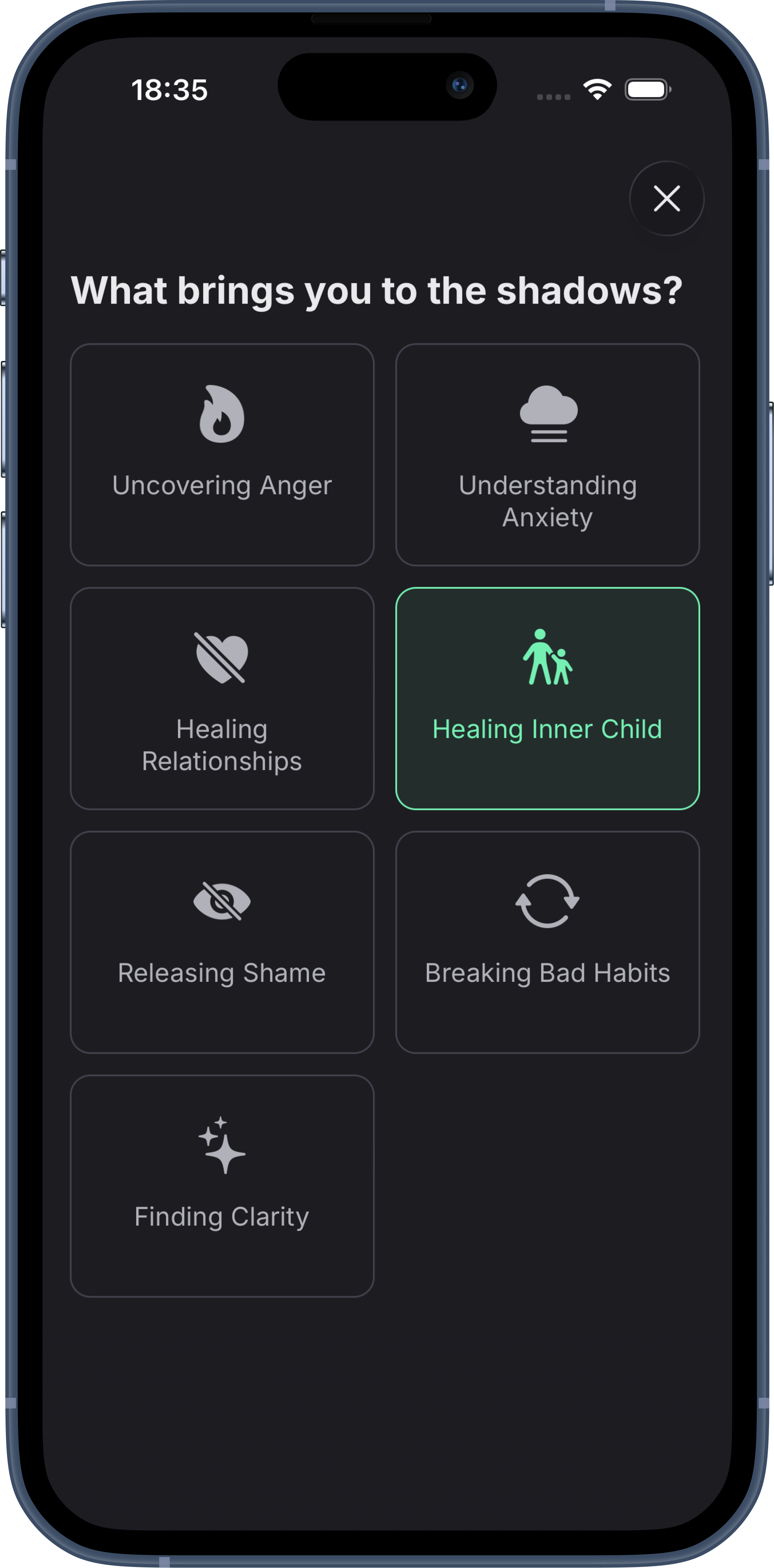
1. Choose Your Intent
Pick a focus area like Anger, Shame, Ego, Fear, or Envy. These intents represent the emotional territory you want to explore during your session.
2. Respond to a Prompt
Umbra presents a psychologically-driven question matched to your chosen intent. Write honestly and without filter — no one will see this but you. Your entries are stored locally on your device and never leave it.
3. Recognize Patterns
Over time, Umbra tracks the distribution of your reflections across different intents. This visualization helps you see which shadows dominate your inner landscape.
4. Integrate
Pattern recognition creates awareness, and awareness creates choice. Umbra's intent analytics visualize how your reflections distribute over time, so you can see which shadows dominate and where you're growing. This is the core of Jungian shadow integration — bringing the unconscious into consciousness.
Frequently Asked Questions
Is my data truly private?
Absolutely. Umbra is built on an offline-first architecture. Your reflections, triggers, and secrets never leave your device and are stored in a local expo-sqlite database. We do not have accounts, and we cannot read your entries.
What is the difference between Gratitude and Shadow Work?
While gratitude focuses on positivity, Shadow Work (rooted in Jungian psychology) is about integrating the repressed parts of your personality—like anger, shame, or envy—to achieve wholeness and clarity. It is "nightwork" for your soul.
Is Umbra a replacement for therapy?
No. Umbra is a tool for self-reflection and pattern recognition. It is designed to complement professional therapy, not replace it. If you are experiencing a mental health crisis, please seek professional help.
How does the "15-entry limit" work?
The free version of Umbra allows you to store up to 15 entries in your entire history to experience the power of the process. To unlock unlimited reflections, advanced analytics, and full prompt selection, you can upgrade to Umbra Premium.
Can I lock my journal?
Yes. You can enable FaceID, TouchID, or a PIN code to ensure that your "Shadow" remains visible only to you. This feature is available for all users, including those on the free tier.
What are "Prompts" and "Intents"?
Intents are focus areas like "Anger" or "Ego". Prompts are deep, psychologically-driven questions designed to trigger honest reflection. In the free version, the app shuffles prompts for you; Premium users can manually refine their focus.
What is shadow work and how do I start?
Shadow work is the practice of exploring the unconscious parts of your personality that have been repressed or denied, a concept popularized by Swiss psychiatrist Carl Jung. Journaling is the most accessible entry point for this practice as it allows you to externalize internal dialogues safely. Umbra provides guided prompts to make this process structured and less overwhelming for beginners. A practical first step is identifying a recurring emotional trigger and writing about its earliest memory.
Is shadow work journaling safe?
Shadow work journaling is generally safe for most people, though it can surface intense emotions and difficult memories. It is important to approach this work with self-compassion and pause the process if you feel overwhelmed or destabilized. Umbra is a self-reflection tool designed for personal growth and is not a substitute for professional therapy or medical advice. If you are dealing with deep trauma or a mental health crisis, please consult with a licensed therapist.
Can I do shadow work on my own without a therapist?
Yes, many people practice shadow work independently through dedicated journaling and self-reflection. Journaling is the most common solo method because it creates a private space for honest confrontation with the self. While a therapist is recommended for processing deep-seated trauma, Umbra is specifically designed to support independent practice with structured, psychologically-driven prompts.
What are shadow work prompts?
Shadow work prompts are psychologically-driven questions designed to surface unconscious patterns, biases, and repressed emotions. These prompts often focus on themes like shame, anger, fear, and envy to help you understand why you react to certain situations in specific ways. Umbra categorizes these prompts by "Intents" such as Anger, Shame, Ego, Fear, and Envy to provide a focused reflection experience. The app offers a selection of free prompts, while Umbra Premium provides full access to the entire library.
What makes Umbra different from other journal apps?
Umbra differentiates itself through three core principles: a structured Jungian psychology framework, absolute privacy, and emotional pattern tracking. Unlike standard gratitude journals, Umbra uses specific prompts to facilitate confrontation work rather than just positive thinking. The app is completely offline-first with no cloud sync or accounts, ensuring your deepest reflections never leave your device. Finally, Umbra visualizes your emotional triggers over time, helping you recognize which shadows dominate your inner landscape.